Blog
Showing 1–12 of 28 posts
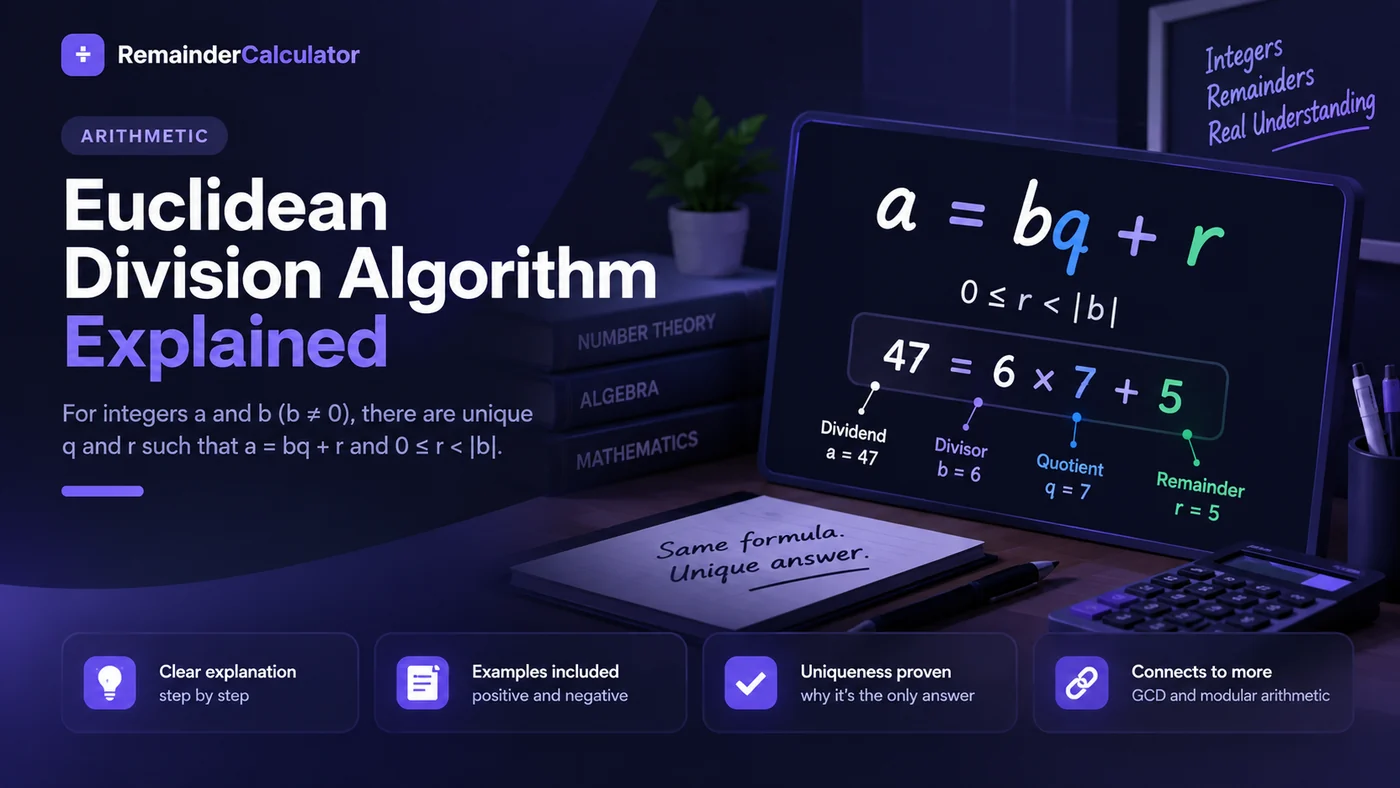
Euclidean Division Algorithm Explained: a = bq + r With Examples
The division algorithm says every pair of integers gives unique q and r with a = bq + r and 0 <= r < |b|. Why they exist, why they are unique, and negative cases.
Read More →
Division With Remainders Practice Problems With Answers
48 graded division with remainders exercises across three levels, with a complete answer key, worked solutions for the hard ones and a self-check method.
Read More →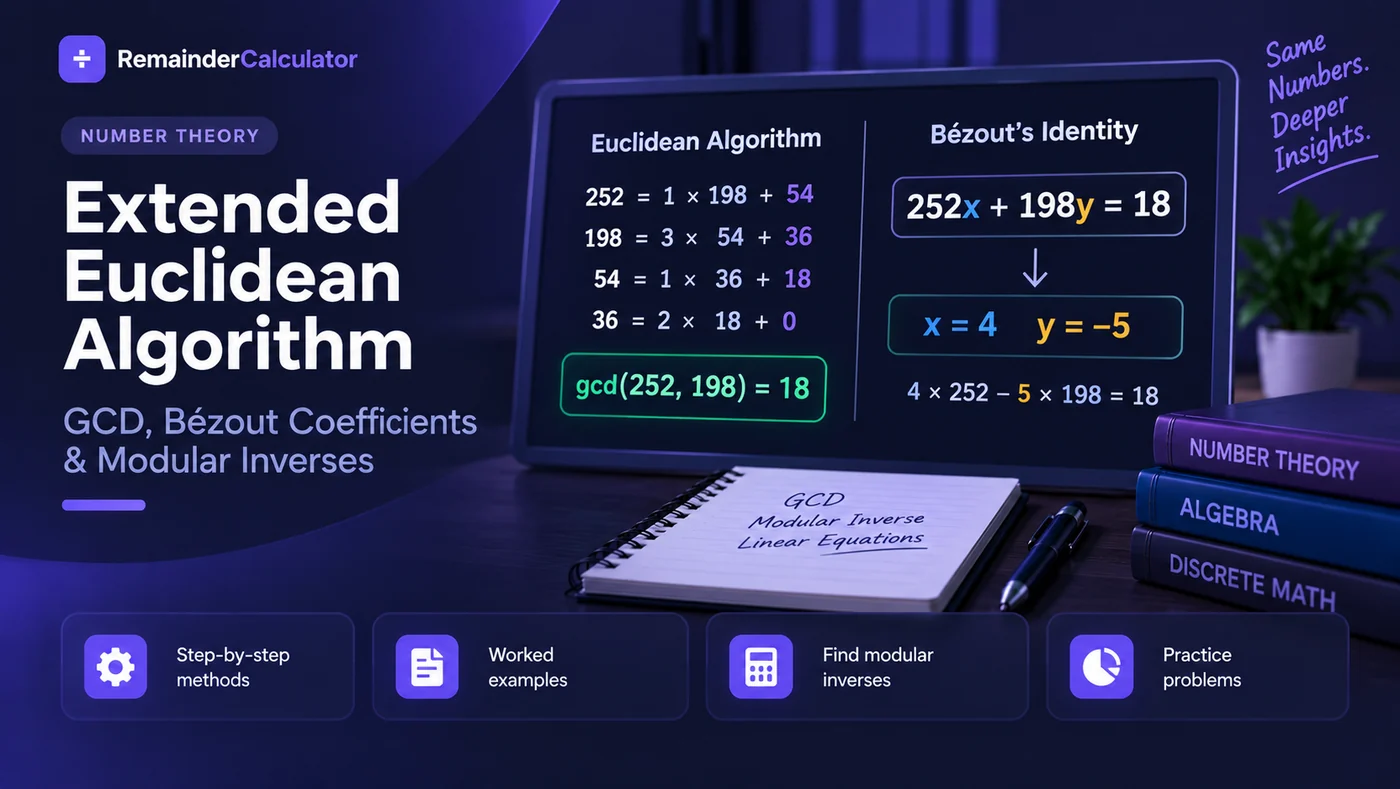
Extended Euclidean Algorithm: GCD, Bézout Coefficients & Modular Inverses
The extended Euclidean algorithm finds x and y with ax + by = gcd(a, b). Both methods worked step by step, the table shortcut, pseudocode and 8 practice problems.
Read More →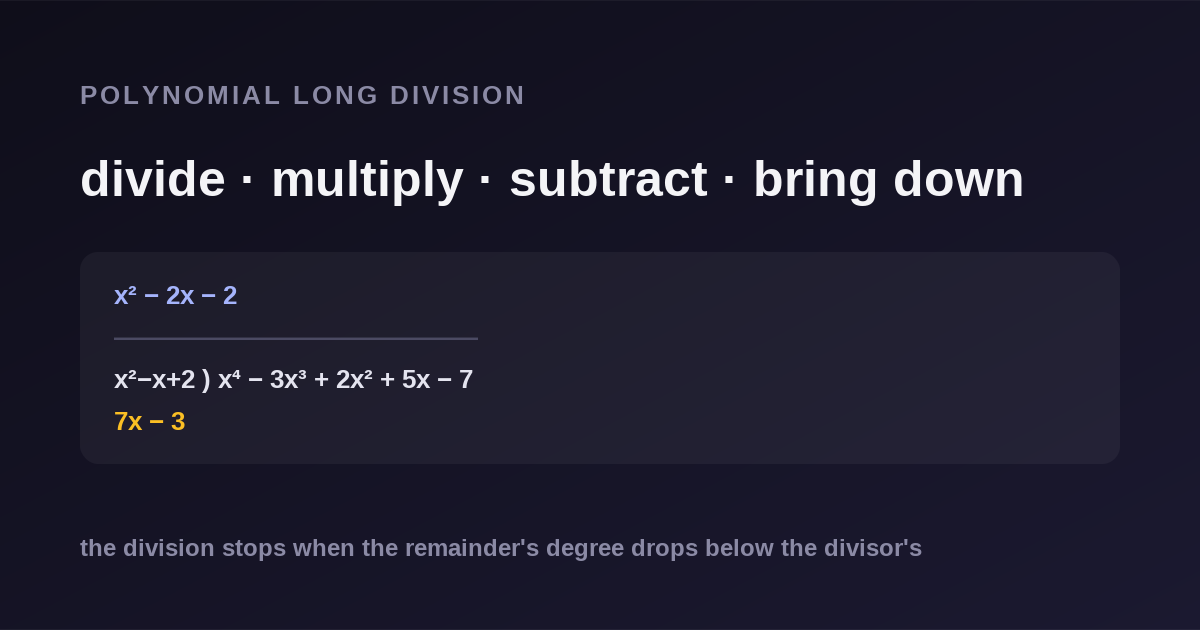
Polynomial Long Division With Remainders: Complete Guide
Divide polynomials by any divisor using long division. The divide-multiply-subtract-bring down cycle, placeholder zeros, quadratic divisors and 8 practice problems.
Read More →
Python divmod(): Get Quotient and Remainder With Examples
divmod(a, b) returns the quotient and remainder as one tuple. Syntax, unpacking, negative operands, float behaviour and when to use it instead of // and %.
Read More →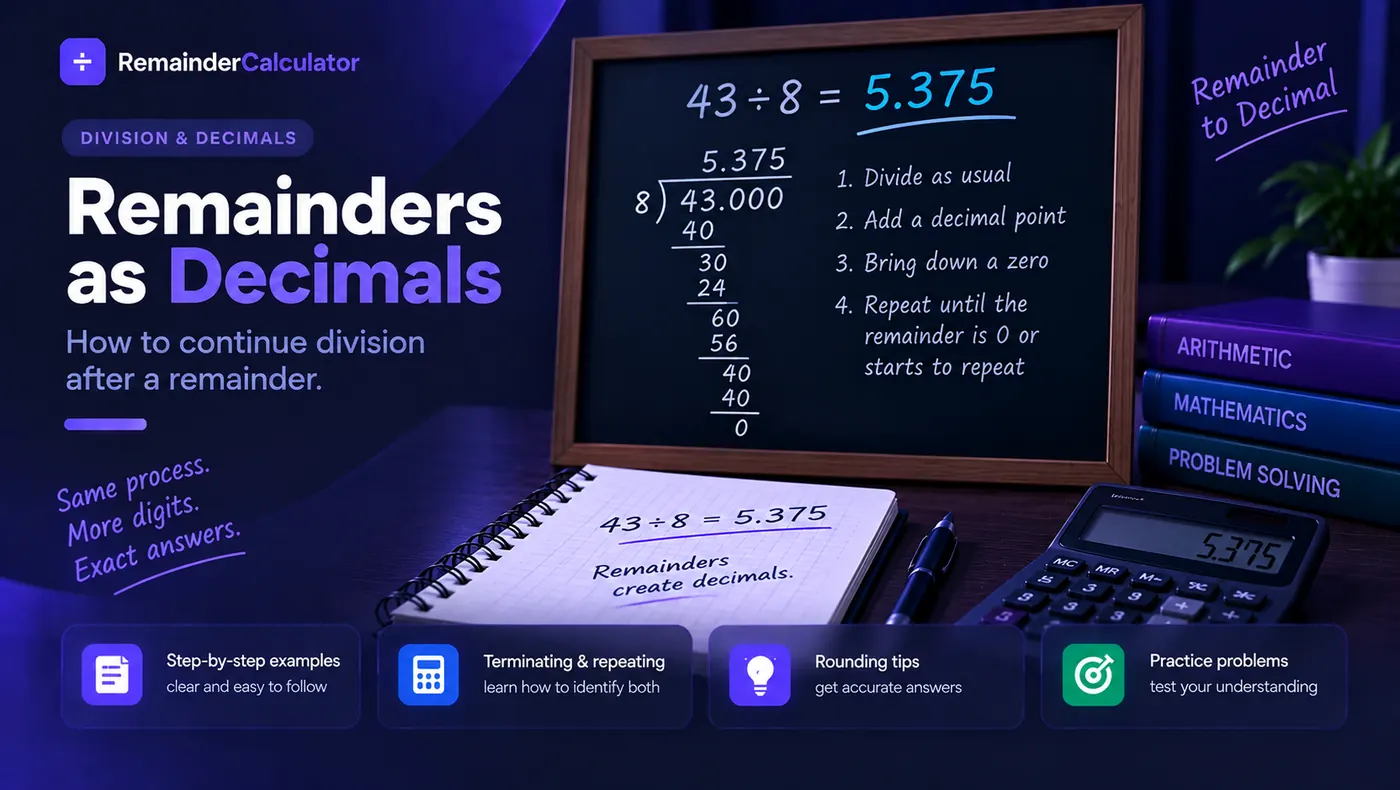
Remainders as Decimals: How to Continue Division After a Remainder
Turn a remainder into a decimal by adding a point and bringing down zeros. Worked long divisions, terminating vs repeating decimals, and how to spot which you get.
Read More →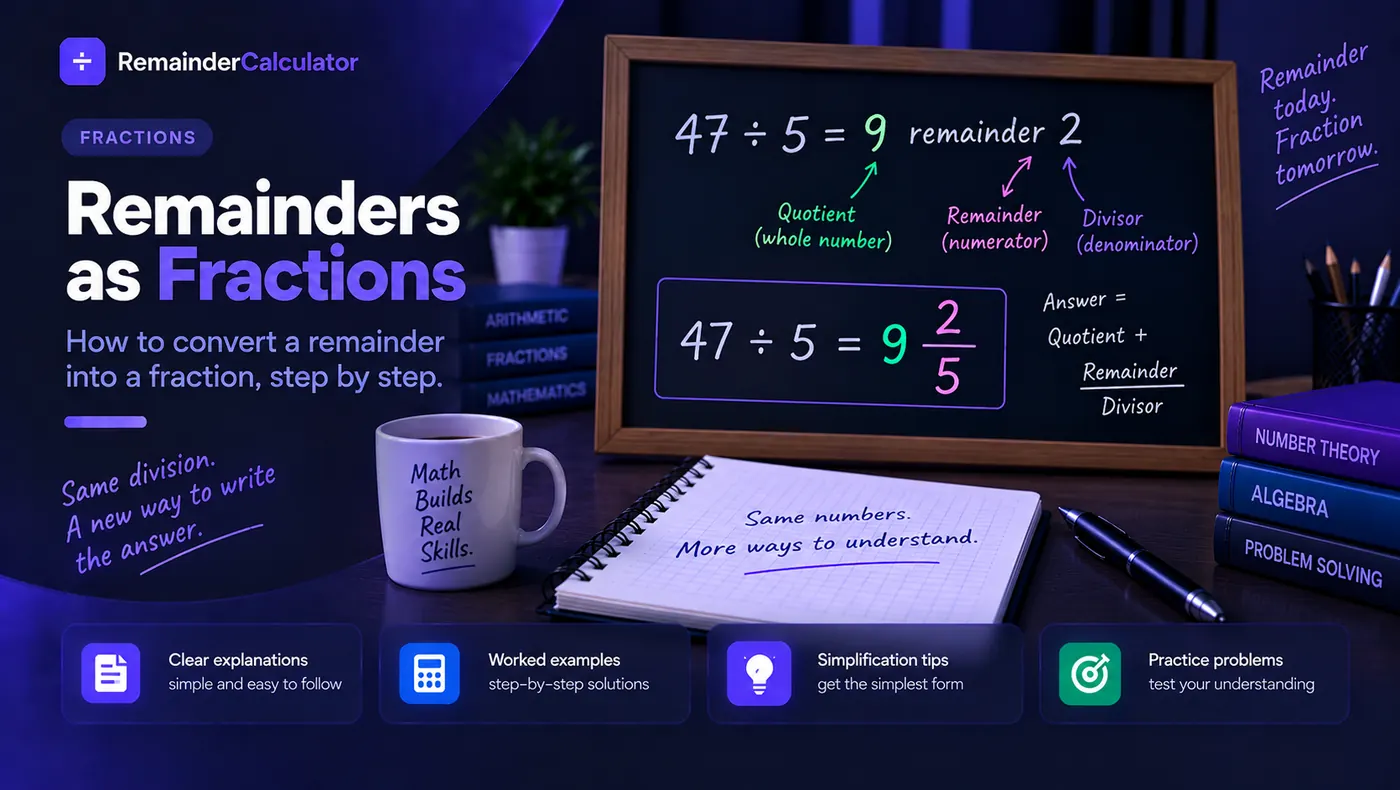
Remainders as Fractions: How to Convert a Remainder Into a Fraction
Turn a remainder into a fraction by writing it over the divisor. The mixed number rule, when to simplify, improper fractions and 10 practice questions with answers.
Read More →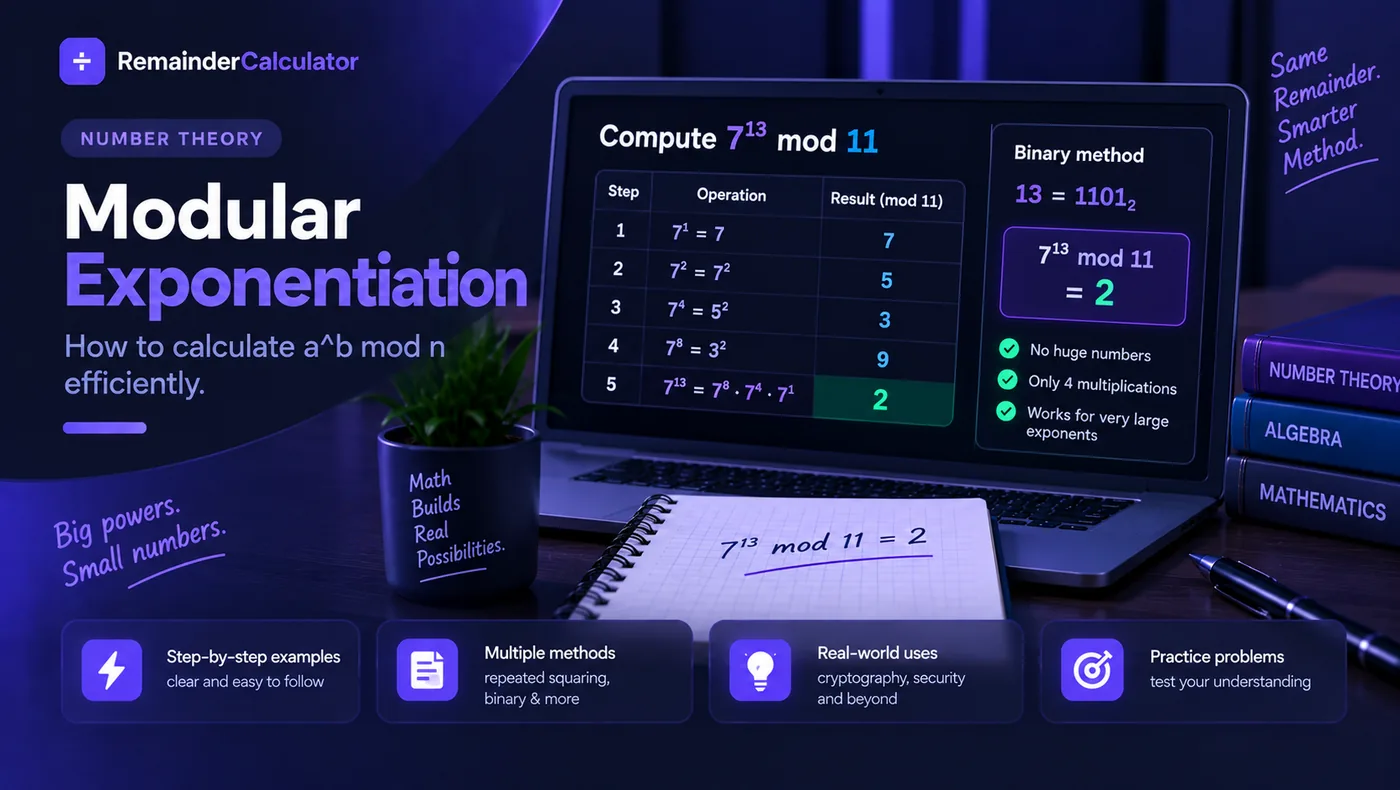
Modular Exponentiation: How to Calculate a^b mod n Efficiently
Compute a^b mod n without ever forming a^b. Reduce as you go, then use repeated squaring and the binary exponent, with full step tables and pseudocode.
Read More →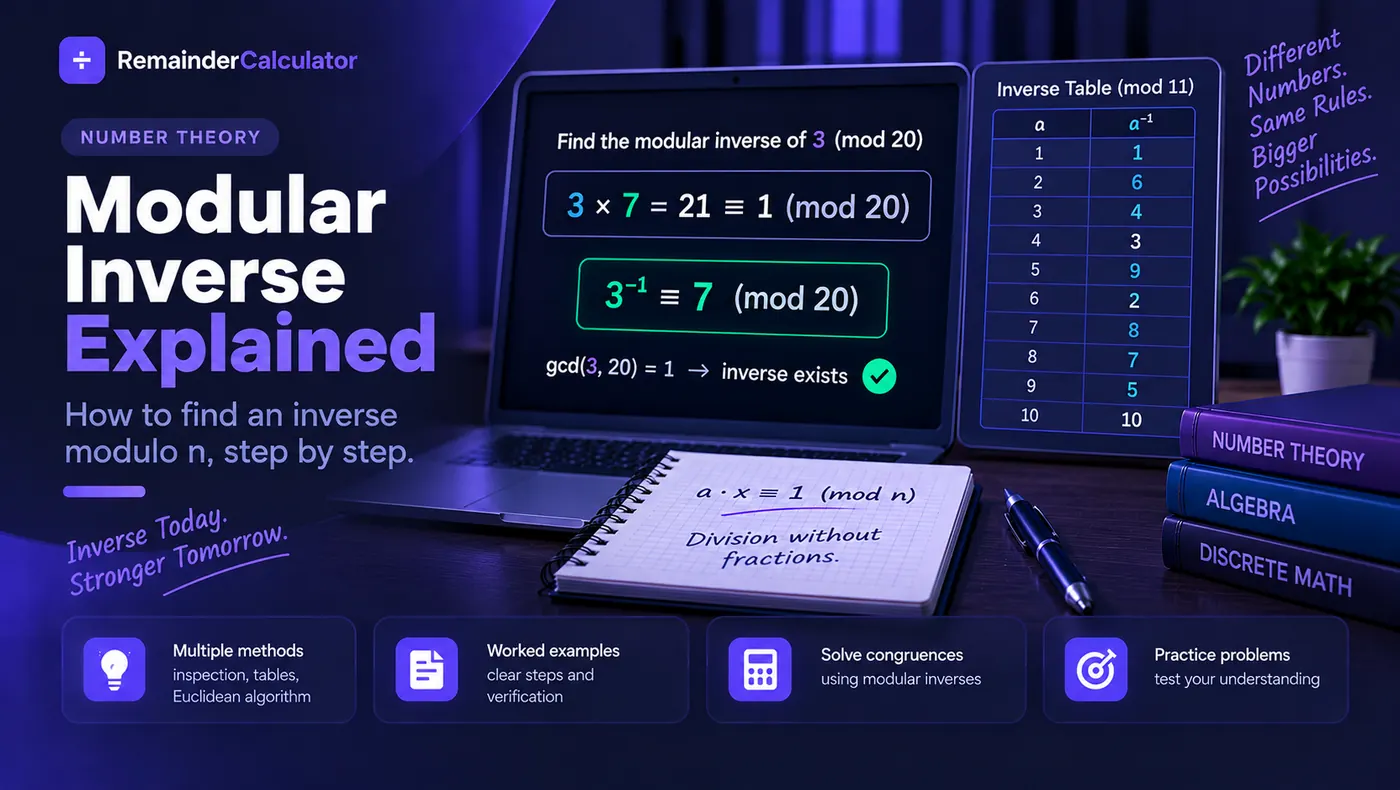
Modular Inverse Explained: How to Find an Inverse Modulo n
A modular inverse of a is the x with ax = 1 (mod n). When it exists, four ways to find it, an inverse table mod 11, and how to solve congruences with it.
Read More →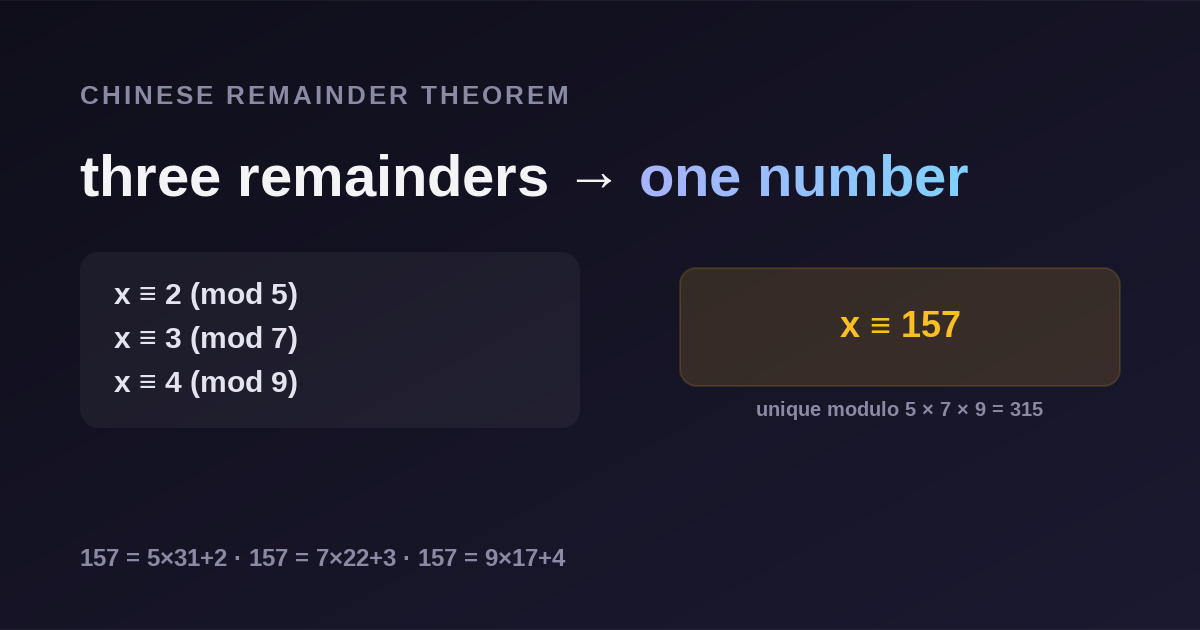
Chinese Remainder Theorem: Step-by-Step Examples and Solutions
Solve systems of congruences with the Chinese Remainder Theorem. The sieve, substitution and construction methods, worked step by step, plus non-coprime cases.
Read More →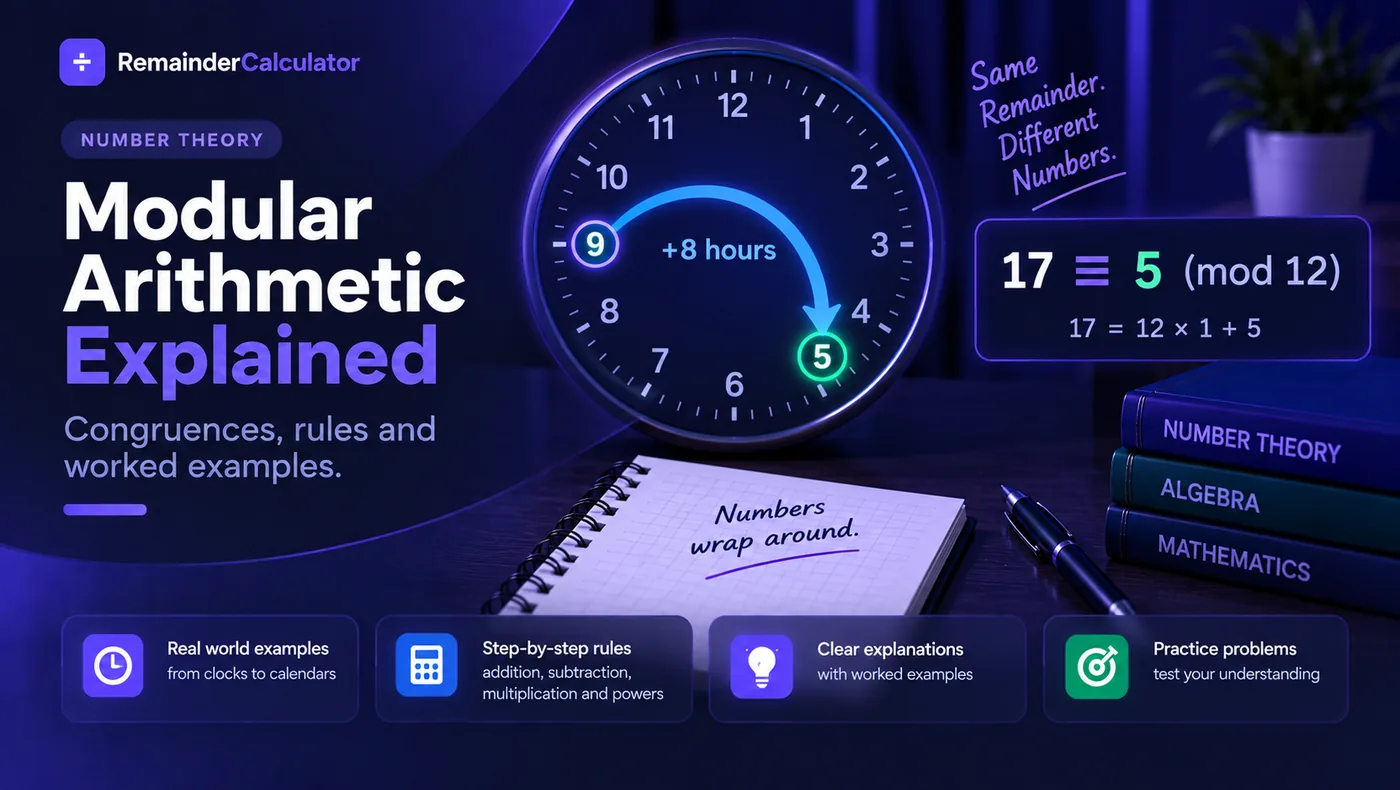
Modular Arithmetic Explained: Congruences, Rules & Examples
Modular arithmetic works with remainders instead of whole numbers. Congruence notation, residue classes, the rules for adding, multiplying and taking powers mod n.
Read More →
Excel MOD Function: How to Find the Remainder in Excel
MOD(number, divisor) returns the remainder in Excel and takes the sign of the divisor. Syntax, cell references, negative values, every nth row and MOD vs QUOTIENT.
Read More →