Blog
Showing 13–24 of 28 posts
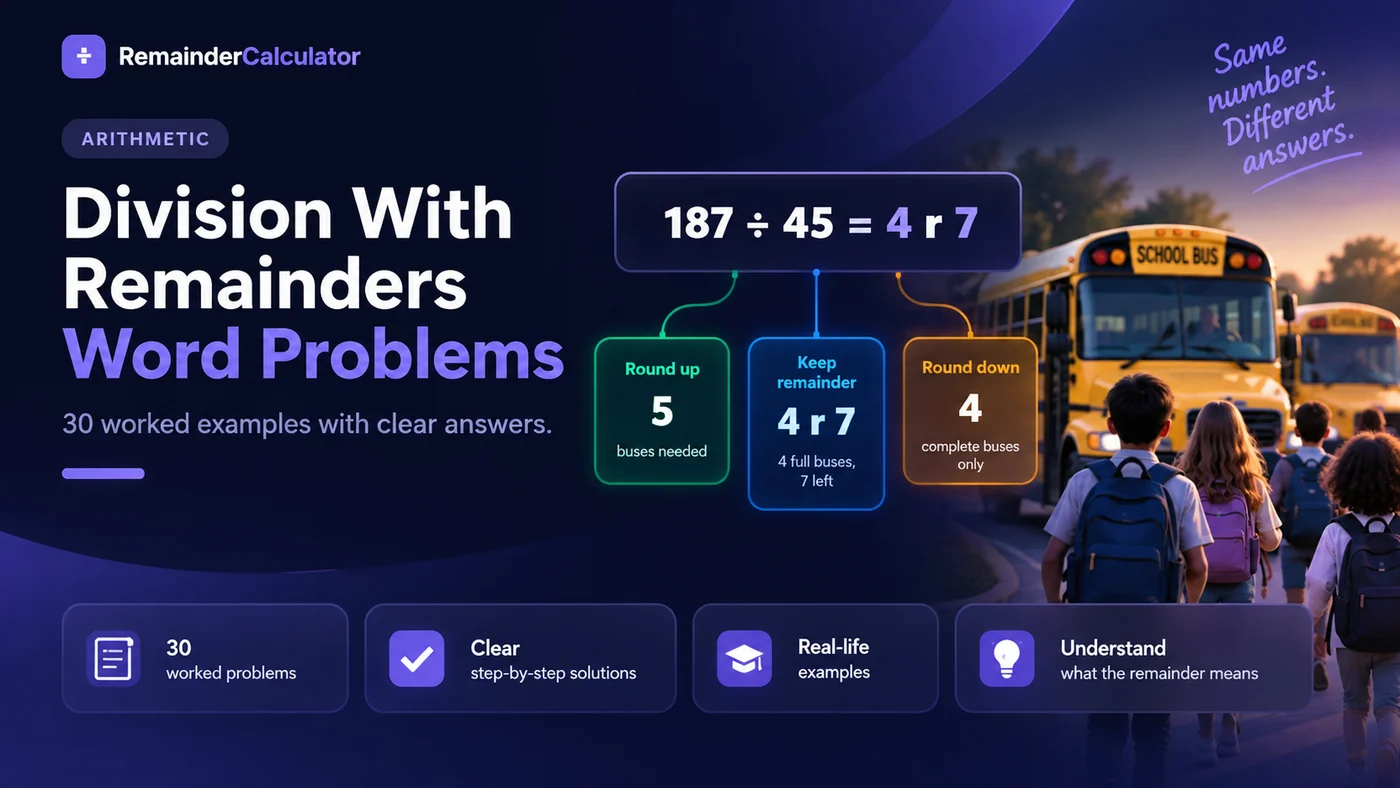
Division With Remainders Word Problems: 30 Worked Examples
30 worked division word problems with remainders, sorted by what the leftover means: keep it, round up, round down, or write it as a fraction or a decimal.
Read More →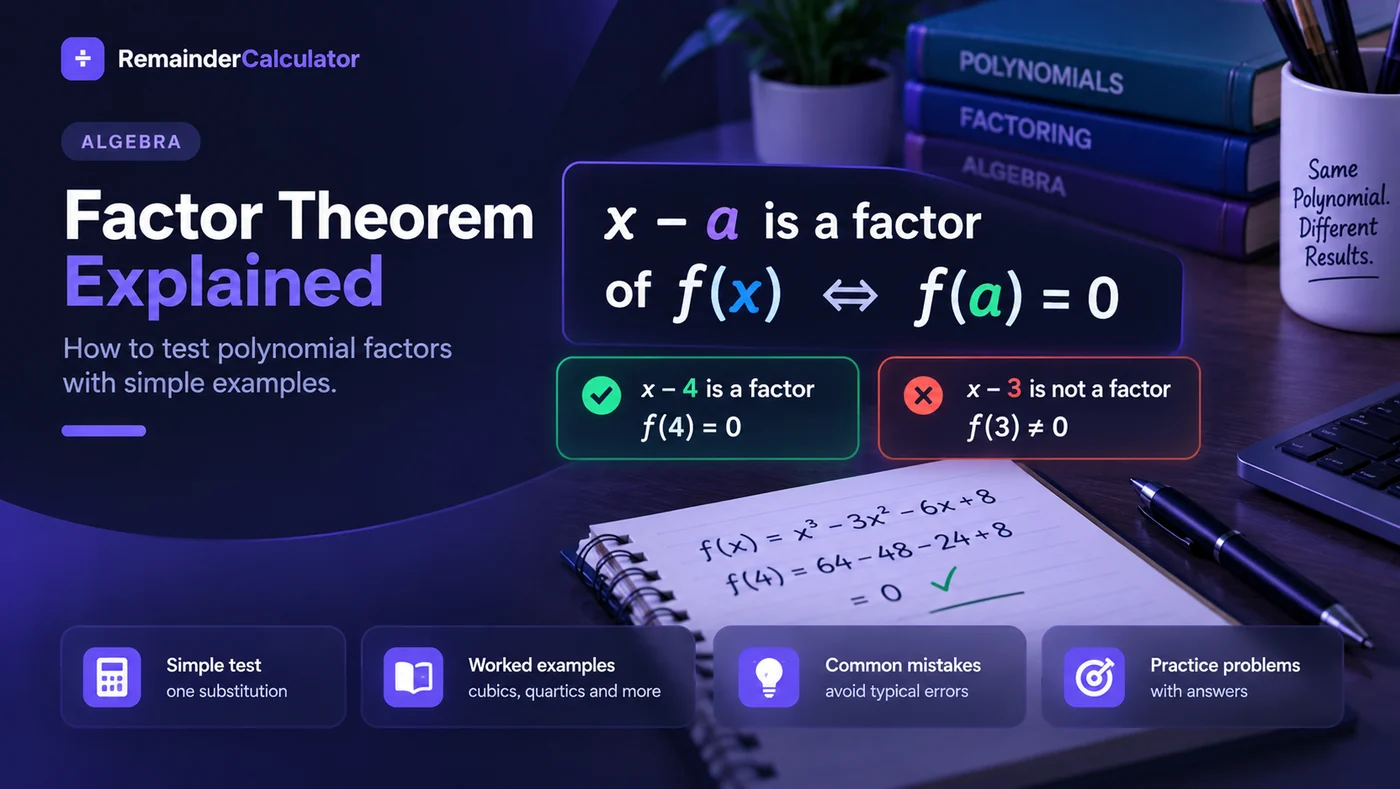
Factor Theorem Explained: How to Test Polynomial Factors
The Factor Theorem says x - a is a factor of f(x) exactly when f(a) = 0. How to test a factor in one substitution, factor cubics fully and find unknown coefficients.
Read More →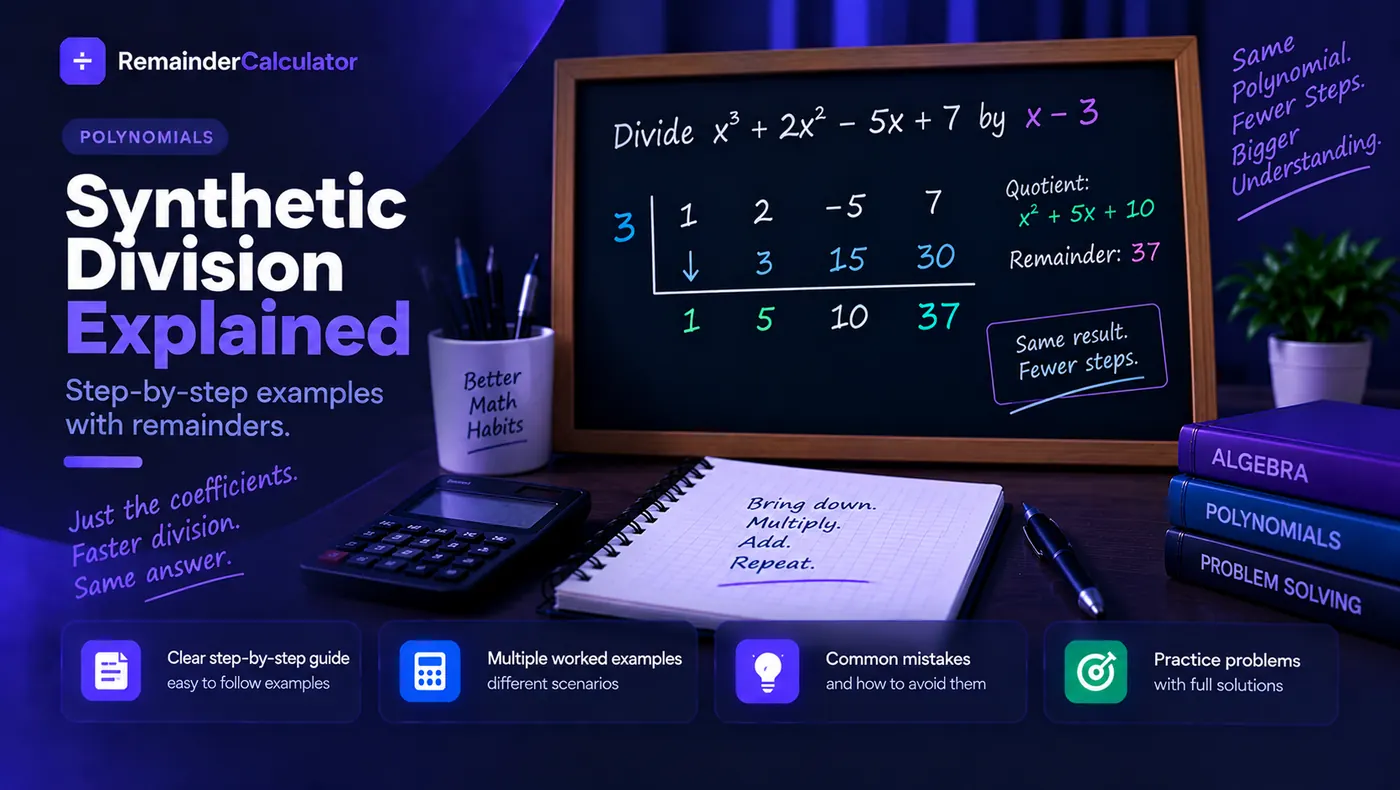
Synthetic Division With Remainders: Step-by-Step Examples
Synthetic division finds the quotient and remainder of a polynomial divided by x - a using only the coefficients. The setup, the multiply-add cycle and 6 examples.
Read More →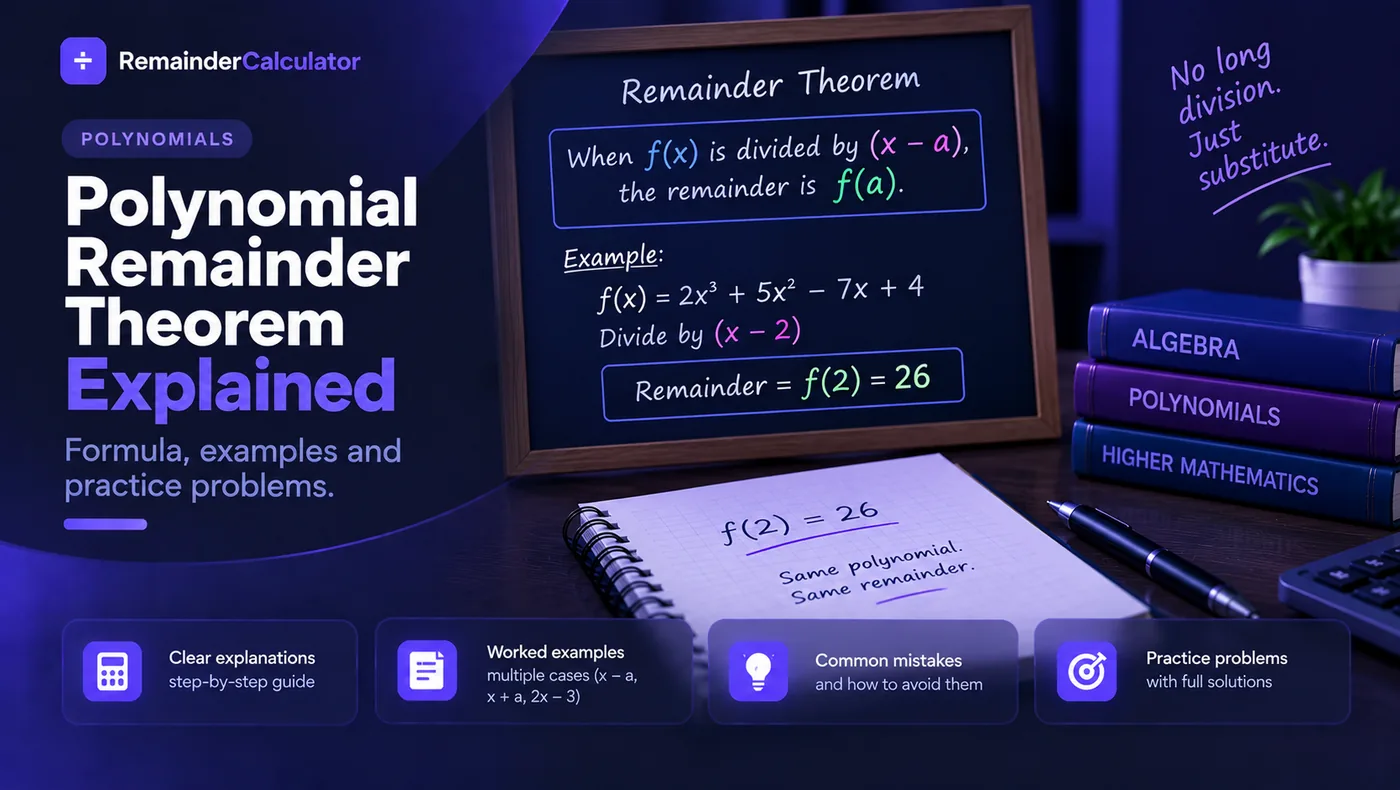
Polynomial Remainder Theorem Explained: Formula, Examples & Practice Problems
The Remainder Theorem says dividing f(x) by x - a leaves f(a). The formula, the proof in four lines, worked examples with x + a and 2x - 3, and 10 practice problems.
Read More →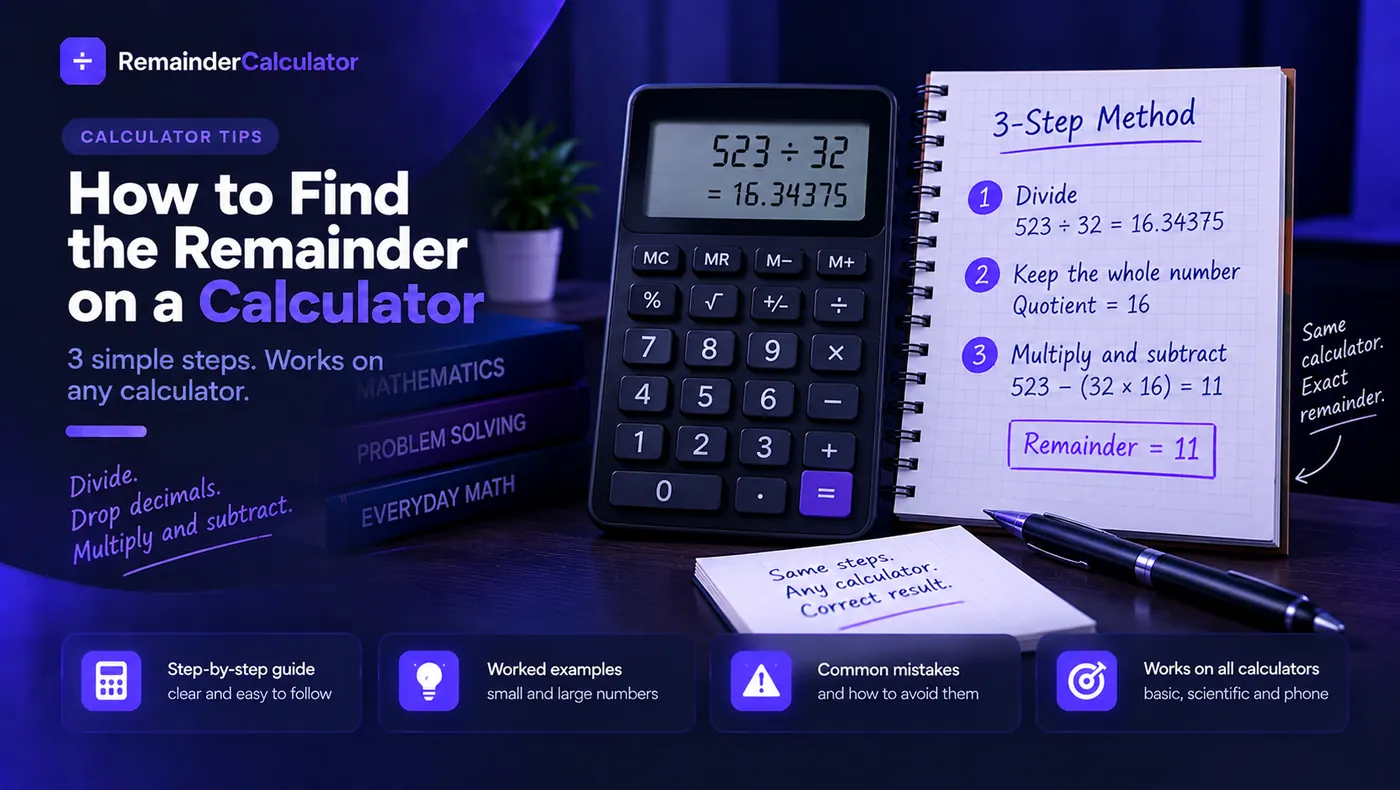
How to Find the Remainder on a Calculator: 3 Steps
Divide, drop the decimals, multiply back and subtract. How to get a remainder on a basic, scientific or phone calculator, and why rounding gives wrong answers.
Read More →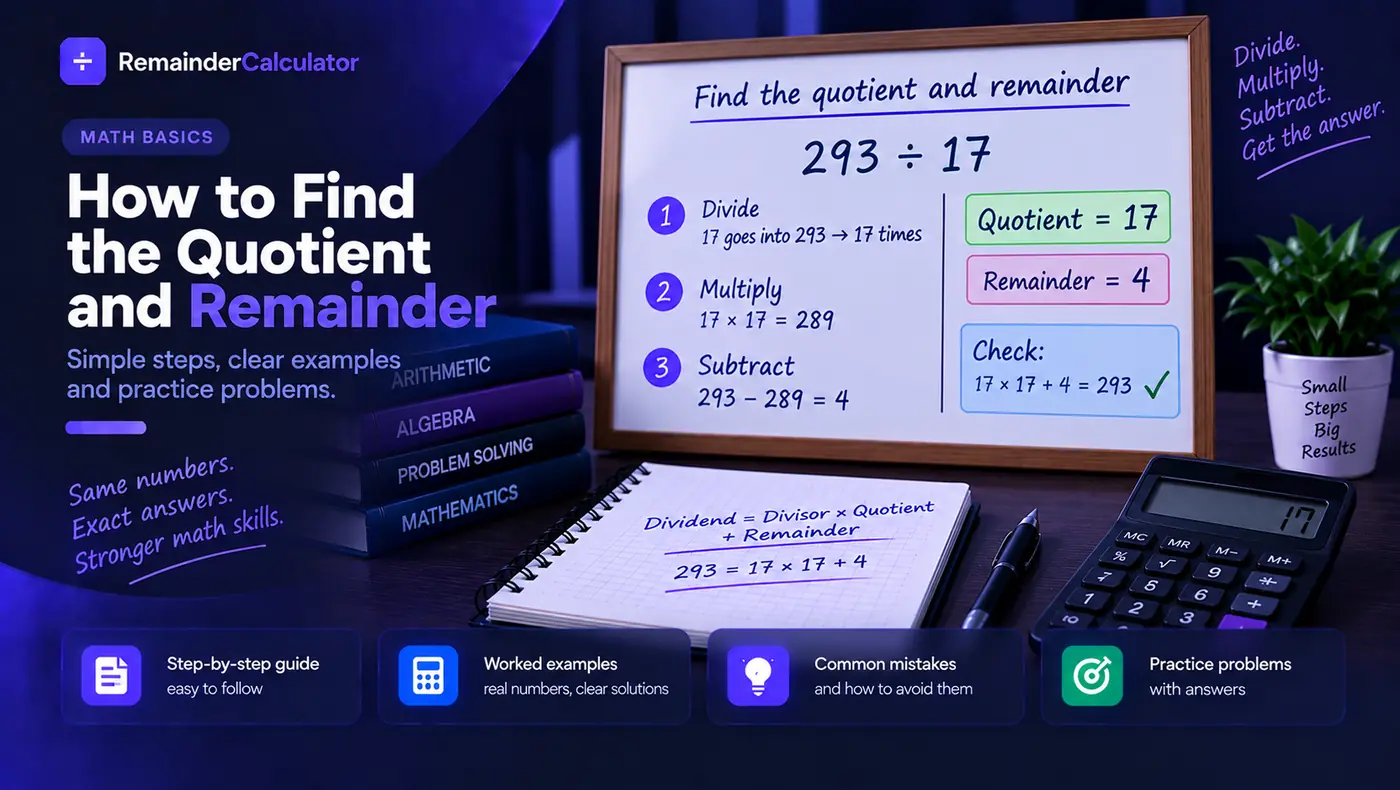
How to Find the Quotient and Remainder: Formula and Steps
Find the quotient and remainder in three steps using Dividend = Divisor × Quotient + Remainder. Worked examples, the nearest-multiple method and practice sums.
Read More →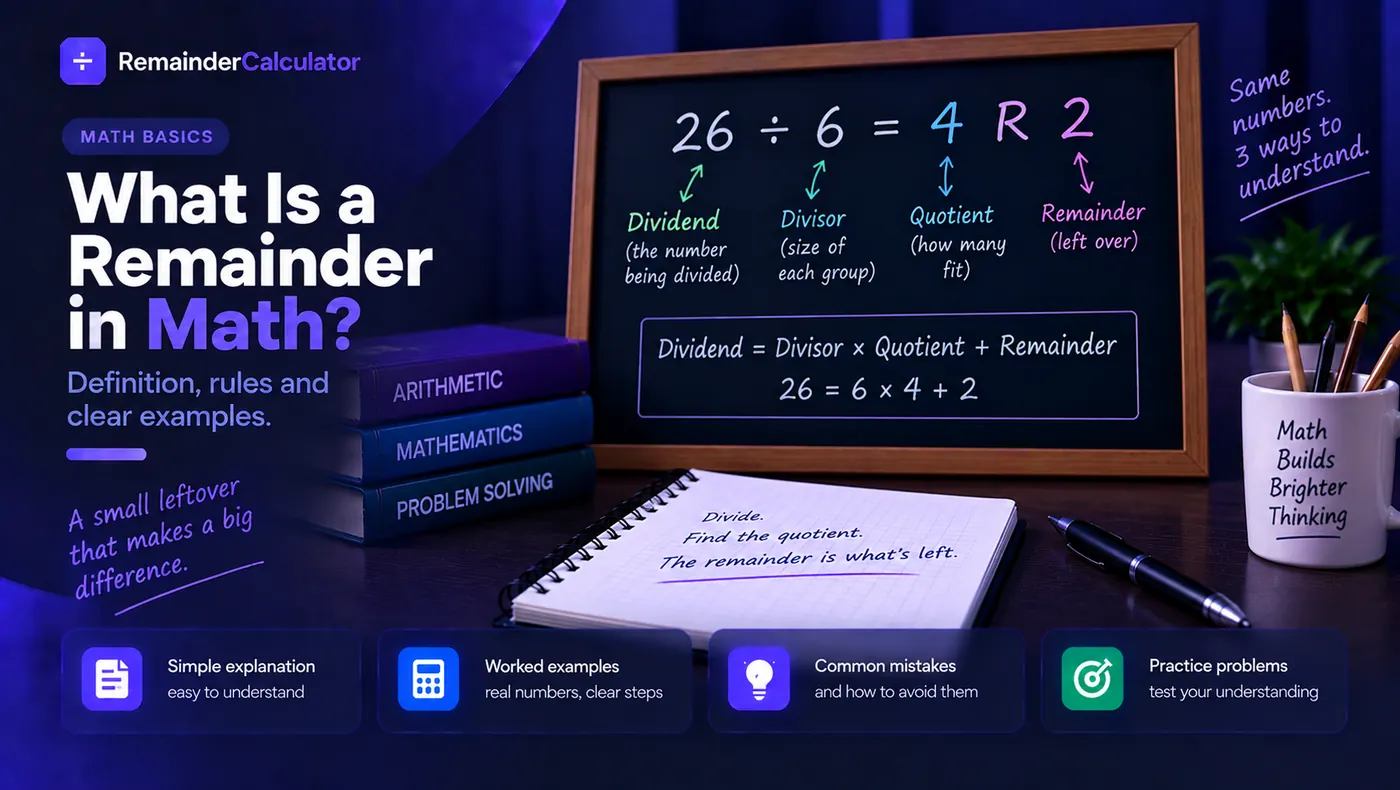
What Is a Remainder in Math? Definition, Rules and Examples
A remainder is the whole number left over when one number does not divide exactly into another. The definition, its two rules and how it fits the quotient.
Read More →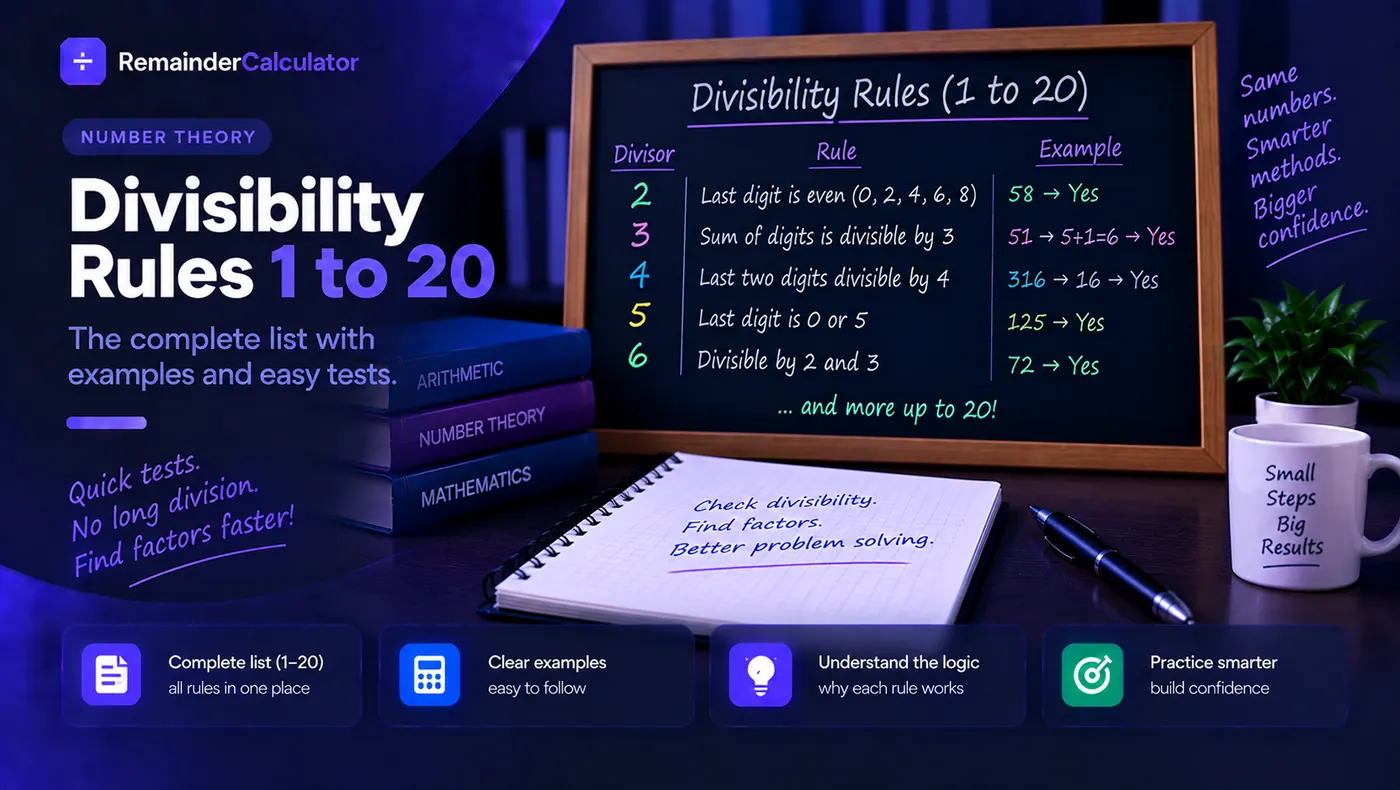
Divisibility Rules 1 to 20: The Complete List With Examples
Divisibility rules for 1 to 20 in one chart. The quick test for each divisor, why digit-sum and alternating-sum rules work, and how they reveal the remainder.
Read More →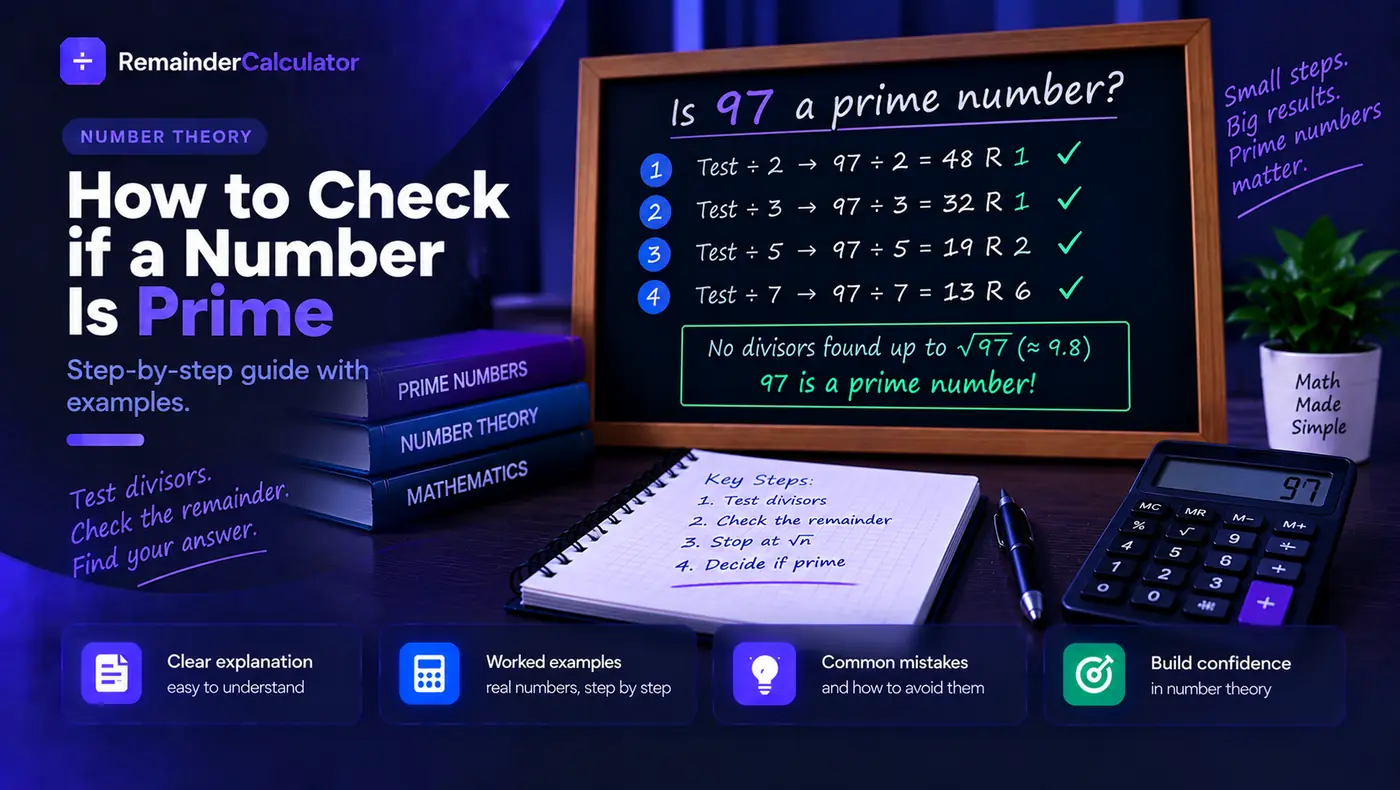
How to Check if a Number Is Prime: Prime Test by Division
To check if a number is prime, test every divisor from 2 up to its square root for a remainder of 0. Learn trial division and the square root shortcut.
Read More →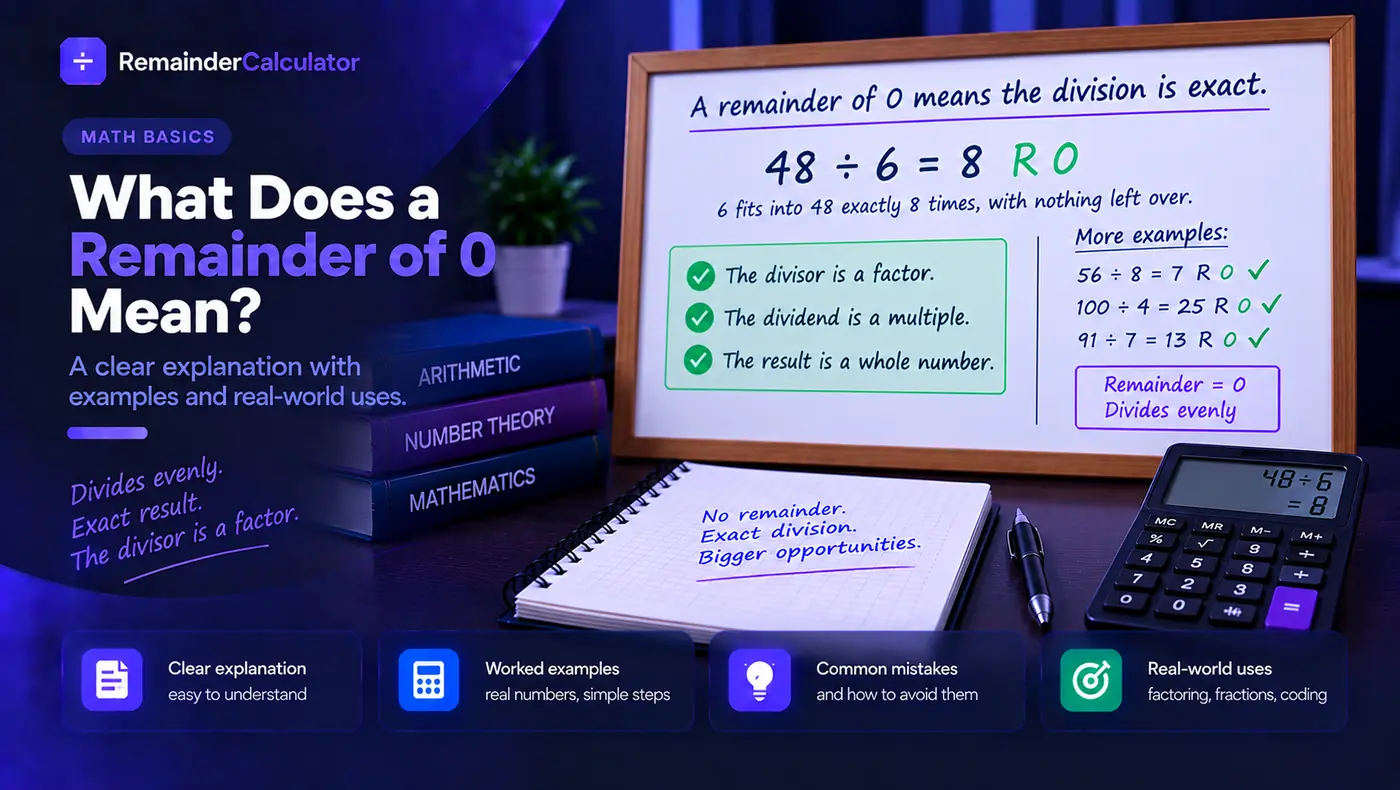
What Does a Remainder of 0 Mean? No Remainder Explained
A remainder of 0 means the dividend is exactly divisible by the divisor. Learn what no remainder means, why it makes the divisor a factor, and where it matters.
Read More →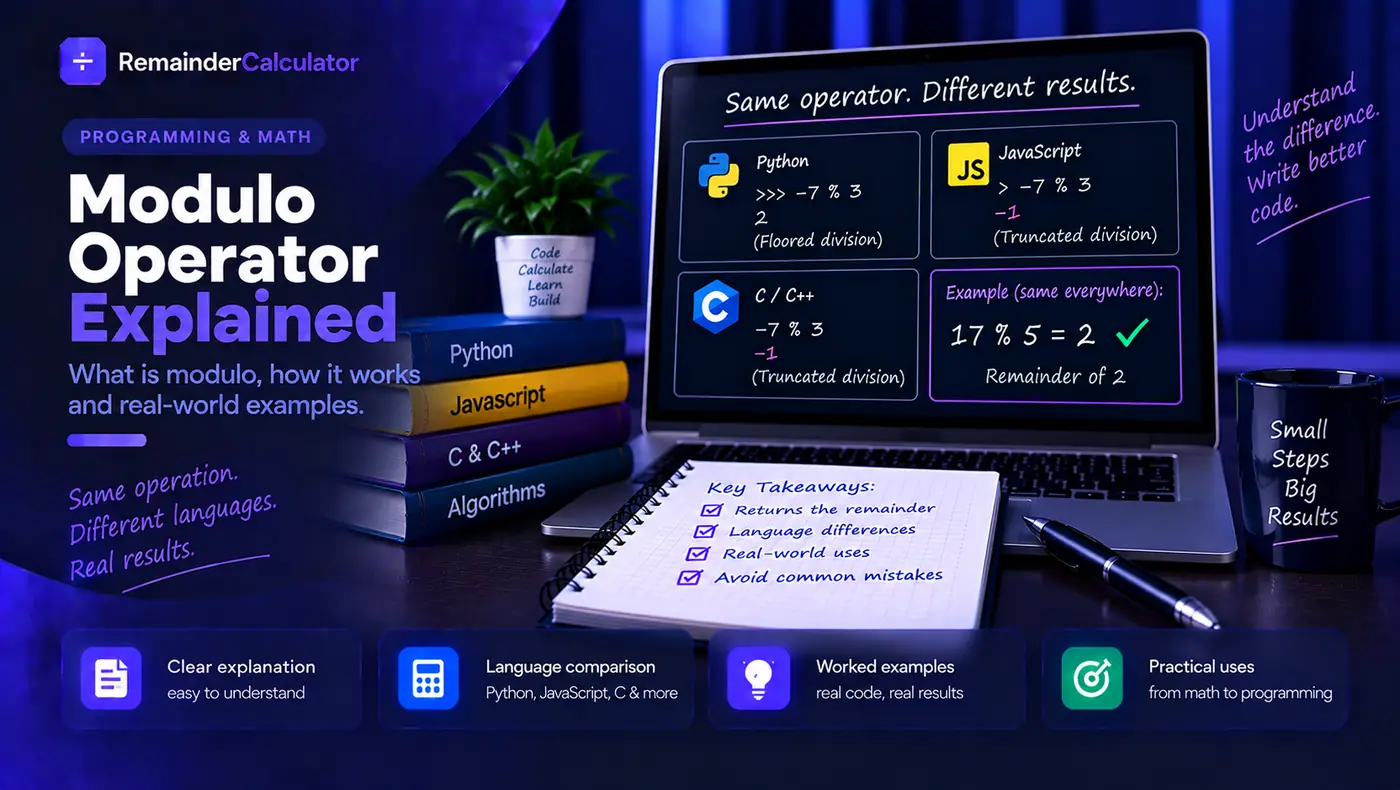
Modulo Operator Explained: What Is Modulo and How Mod Works
The modulo operator returns the remainder of a division. Learn what modulo means, how mod works in code, its precedence and its negative-number behaviour.
Read More →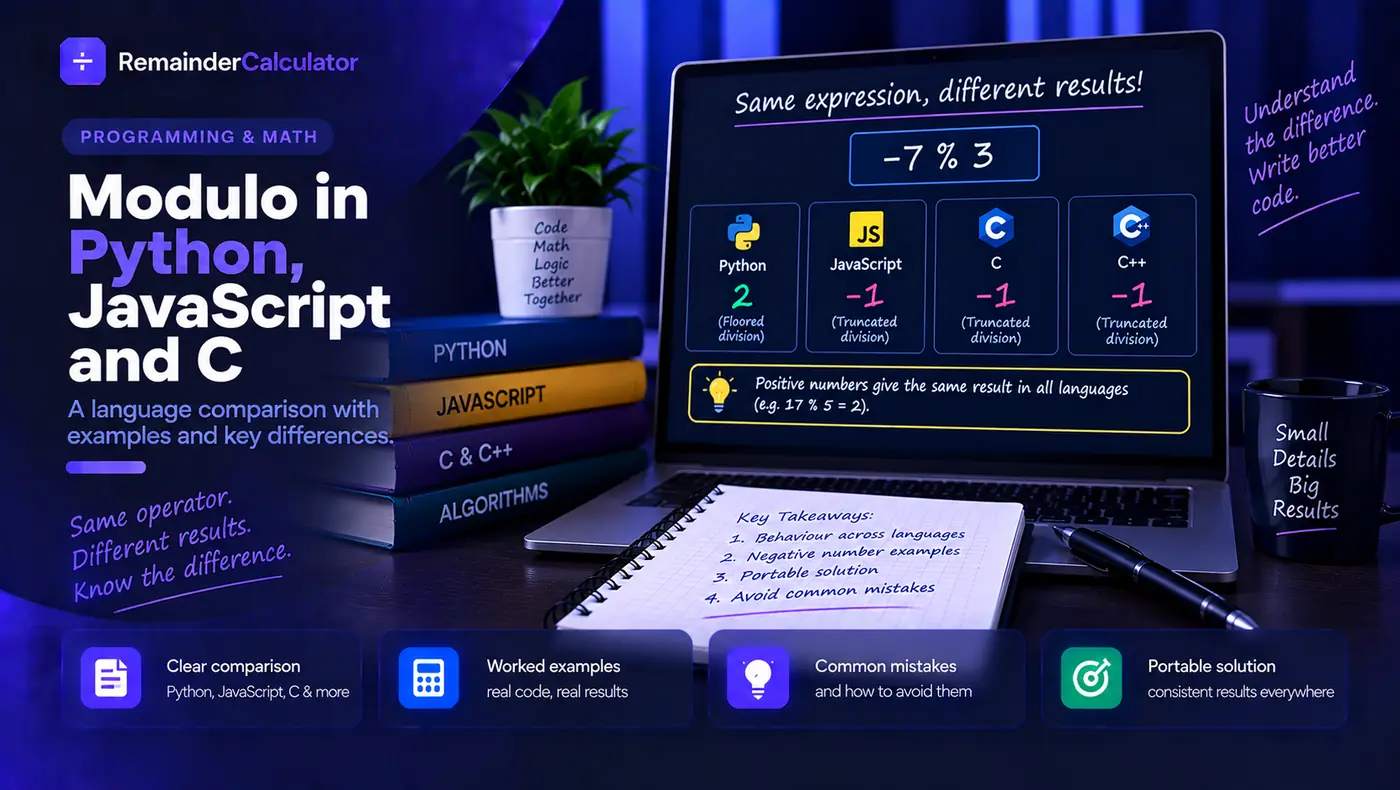
Modulo in Python, JavaScript and C: A Language Comparison
The % operator behaves differently across languages. Compare modulo in Python, JavaScript, C and Java, with negative-number results and portable code patterns.
Read More →